In my previous post I started looking at Juno's trip to the Underworld. In addition to the male villains we looked at last time, she also saw the Danaides.
Salieri's opera Les Danaïdes was first staged in 1784. The YouTube extract below has the Danaides's entry after murdering their husbands.
Liverpool's Walker Gallery has Rodin's Danaid, with extensive commentary and a downloadable gallery talk on the piece. Perhaps the most famous picture of the Danaides is the 1903 painting by Waterhouse shown below (now in a private collection). (public domain image from wiki commons)
Sargent's 1922-1925 picture of the Danaides is in Boston's Museum of Fine Arts. (public domain image from museum syndicate)
Juno's purpose in going down to the Underworld was to recruit Tisiphone, one of the Furies, to drive Athamas, Ino's husband, into a state of madness in which he would cause the death of his family. Muziamo's 1548 picture of Athamas is in Tivoli's Villa d'Este.
Two reviews of Telemann's 1765 dramatic cantata, Ino, are reviewed here.
The 1801 picture of Athamas below is by Migliarini and is now in Rome's Accademia Nazionale di San Luca, but is not on their website. (public domain image from wikicommons)
In Ovid's next story, Juno gets angry with Ino, Semele's sister, and decides to punish her. This involves a trip down to the underworld, where she comes across some people being punished for their crimes on Earth. In this post we'll be looking at the punishments suffered by four of these people:Tityus, Tantalus, Sisyphus, and Ixion. (all of the images below are in the public domain and taken from wikicommons)
Both Titian and de Ribera painted sets of four paintings, one for each of the four. The two paintings by Titian above show Tityus (top) and Sisyphus (bottom). Dating from 1548-1549, they are now in Madrid's Prado ( here and here). The other two paintings in the set, Tantalus and Ixion, were unfortunately lost in a fire in 1734. Two of de Ribera's 1632 paintings are also in the Prado: Tityus and Ixion (below).
Michelangelo's 1532 drawing of Tityus is in the Royal Collection, and was used by Bernardi as the design for the intaglio shown below, which was cut around 1530 and is now in London's British Museum.
A drawing of Tantalus by Hans Holbein the Younger dating from between 1535 and 1540 can be seen in Washington's National Gallery of Art. Assereto's picture of Tantalus is from the first half of the 17th century and is now in Graz's Landesmuseum Joanneum (scroll down). Eric Henry has an animated version of Tantalus's torments called Sometimes I Feel Like This on his Moving Pictures site.
The picture of Sisyphus below was painted in 1920 by Franz von Stuck and is now in a private collection. The contemporary artist Michael Egbert took the theme of Sisyphus Sleeping for a 1993 painting.
To finish off this post with, here is Jankovics Marcell's short animated film called Sisyphus, which was nominated for a 1976 Oscar.
Despite his key role in drama, the story of Tiresias has not really proved inspirational to artists. He puts in a rare appearance in this picture from a private collection, which links Tiresias's story to the next story, that of Echo and Narcissus with a prophesy of Narcissus's fate. The stories of Echo and Narcissus were originally two separate stories, which Ovid, as far as we know, was the first to combine. (public domain picture of narcissi by bormaniuss via wikipedia)
Echo was a nymph who covered for Jupiter on one of his amorous forays by distracting Juno with her chatter. As a punishment Juno condemned her to only be able to repeat the last words anyone said. Echo fell in love with the handsome Narcissus, who spurned her, and all the others (male and female) who desired him. One rejected lover cursed him, wishing that he would fall in love with someone unobtainable. When Narcissus saw his reflection in a lake, he fell in love but was unable to reach this bewitching figure. Unable to leave the image of his love, Narcissus died and was changed into the flower that bears his name. Echo also wasted away so that only her voice, still repeating people's last words, is heard in lonely places.
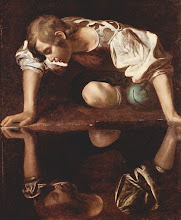
Our first two pictures show Narcissus by himself. The above 1595 picture of Narcissus by Caravaggio is now in Rome's Galleria Borghese. For some reason it is only on the Italian version of the site, and not on the English version. Jacob Pynas painted a Mountain Landscape with Narcissus in 1628, now in London's National Gallery. (public domain picture via wikicommons)
Poussin painted two versions of the story, the earlier (above left) from around 1630 is now in the Louvre, while the later (above right) is in Dresden's Gemäldegalerie Alte Meister (use Narziss as the search item in the box marked Volltextsuche in der Motivliste. Why they don't allow direct links I don't know). At about the same time Claude Lorrain painted a Landscape with Narcissus and Echo, now in London's National Gallery. (public domain pictures via wikipedia)
Turner's picture of Narcissus and Echo (now in London's Tate Gallery) was painted in 1805, while a year earlier the American painter Benjamin West painted the above painting (now in a private collection). (public domain picture via Museum Syndicate)
This 1881 picture of Narcissus by Benczúr Gyula is now in Budapest's Magyar Nemzeti Galéria, but does not appear to be on their website. (public domain picture via wikicommons)
Perhaps one of the most popular paintings of Echo and Narcissus, the above picture by John William Waterhouse was painted in 1903 and is now in Liverpool's Walker Art Gallery. A site devoted to Waterhouse has an article on the models who posed for the picture. Almost as popular is Salvador Dali's Metamorphosis of Narcissus, painted in 1937 and now in London's Tate Gallery.(picture courtesy of WebMuseum under Creative Commons 3.0 licence)
In the performing arts, Guillaume Apollinaire wrote Les Mamelles de Tirésias in 1903, though it was not performed until 1917. Poulenc wrote an opera based on Apollinaire's Les Mamelles de Tirésias during the Second World War and it was first performed in 1947. In 1951 Constant Lambert's ballet about Tiresias was first performed.
Gluck wrote an opera on Echo and Narcissus in 1779. YouTube has an aria. YouTube also has a pas de deux called Echo and Narcissus, though only the dancers are named, not the composer. I'm no expert but I certainly don't think it's the Lambert one. There are the usual kids in bedsheets dramatisations, and this rather nice short film called "An Echo of Narcissus", though Echo doesn't seem to appear.
oblong (and a bit about ovals)
-
Ben Zimmer forwarded me this post from Threads, in which the writer Ruth
Ware finds a transatlantic difference between AmE and BrE interpretations
of *ob...
Is Southwest or American airline better?
-
Is Southwest or American Airline Better? The Definitive Guide The choice
between Southwest and American Airlines boils down to individual
priorities. If ...
Horrible Histories: The Movie: Rotten Romans
-
The original *Horrible Histories* books (the first was *The Terrible Tudors*
in 1993) came out while I was right in the target age group, and they were
...
2018 books chats - corrected
-
January 3 & 17, February 7 Three Stones Make A Wall by Eric Cline eBook
Author chat February 21 I Am Livia by Phyllis T Smith eBook March 7 & 21
Catullus's...
Latest edition of Antiquity
-
The latest edition of Antiquity is worth a look. Two articles in particular
are of especial interest: Discovery of an enormous late Viking Age fort in
Denm...
Grenfell Tower and the Fire of Rome
-
There was a good episode of The Long View on Radio 4 last week, looking at
a terrible fire in Glasgow in 1905 as a ghastly parallel of the Grenfell
Tower. ...
A LEADING LADY IN ELEPHANTINE ON THE NILE (UPDATED)
-
*Meet Lady Sattjeni, daughter of Governor Sarenput the younger.*
I'd love to be able to tell you what she looked like ... but, really, I
can't. Her funerar...



 Posts
Posts


