Showing posts with label boucher. Show all posts

27 August 2008

Europa - the 18th and 19th Centuries

After previous posts covering Europa in the 15th and 16th centuries and in the 17th century, I'd like to move on to the 18th and 19th centuries.

These two pictures were painted around 1720, the one on the left by Tiepolo (now in Venice's Galleria dell'Academia but not on their website) and the one on the right by Ricci (now in Rome's Palazzo Taverna, no website, but see this view and further information (click on loudspeaker for audio commentary as well) from when the picture was exhibited at the National Gallery of Australia).

Ferretti painted a Rape of Europa from 1728 to 1737. It is now in Florence's Galleria Uffizi, though it was displayed for a long time in the Chamber of Deputies of the Italian Parliament, whose website shows the central part of the picture. A better reproduction can be seen at the Web Gallery of Art. At much the same time, Boucher also painted a Rape of Europa, now in London's Wallace Collection.


Shortly afterwards in 1750, Pierre painted this version, now in the Dallas Museum of Art (not possible to link directly -- go to View, then Collections and search for Abduction of Europa).


Gustave Moreau seems to have painted Europa at least five times in the last third of the 19th century though hard and fast information is hard to come by. The above picture is in Moreau's former home, which he left to the nation and is now the Musée Gustave-Moreau (not on the museum's website but in the French Ministère de Culture's Jaconde database, together with another picture of Europa -- to see studies towards these pictures click on the 1 near the bottom of the page).


This version of Europa by Moreau is in Hartford's Wadsworth Atheneum, again not on the museum's website. Moreau did other paintings of Europa, one of which is now in Paris's Musée d'Orsay and another one in Rouen's Musée de Beaux-Arts (not on the Museum's website but on this commercial site).

An 1872 terracotta of Europa and the Bull by Louis Hubert-Noel is now in South Carolina's Columbia Museum of Art. (All illustrations in the public domain via wiki commons media)

17 July 2008

Callisto -- Paintings

(Picture by Torsten Bronger via wikipedia, used under GNU Free Documentation License)

As I said in a previous post, Jupiter's attempt to seduce Callisto and the discovery of her pregnancy by Diana have proved the main focus in the story for artists. Earlier artists (in the 16th century) seem to have been more attracted to Diana's discovery of Callisto's pregnancy, while later artists (in the 18th century) seem to have been more attracted to Jupiter's attempt to seduce Callisto. The 17th century presents more of a mixture of these themes.

Dosso Dossi painted the incident in 1528. The painting is now in Rome's Galleria Borghese but does not seem to be on their website.


Below are two versions of the subject by Titian: the top one is from the late 1550s and is now in Edinburgh's National Gallery of Scotland while the bottom one is from 1566 and is now in Vienna's Kunsthistorische Museum.


Paul Bril painted a landscape with Diana and Callisto, probably in the 1620s, while in the late 1630s Hendrick Bloemart painted this version of the scene (right).


Left is a 17th century engraving by Gérard de Lairesse while below left is an engraving based on a picture from the 1740s by Jacopo Amigoni. Although many art poster and reproduction sites on the internet offer colour pictures, none of the ones I've looked at give any information as to where the original might be.


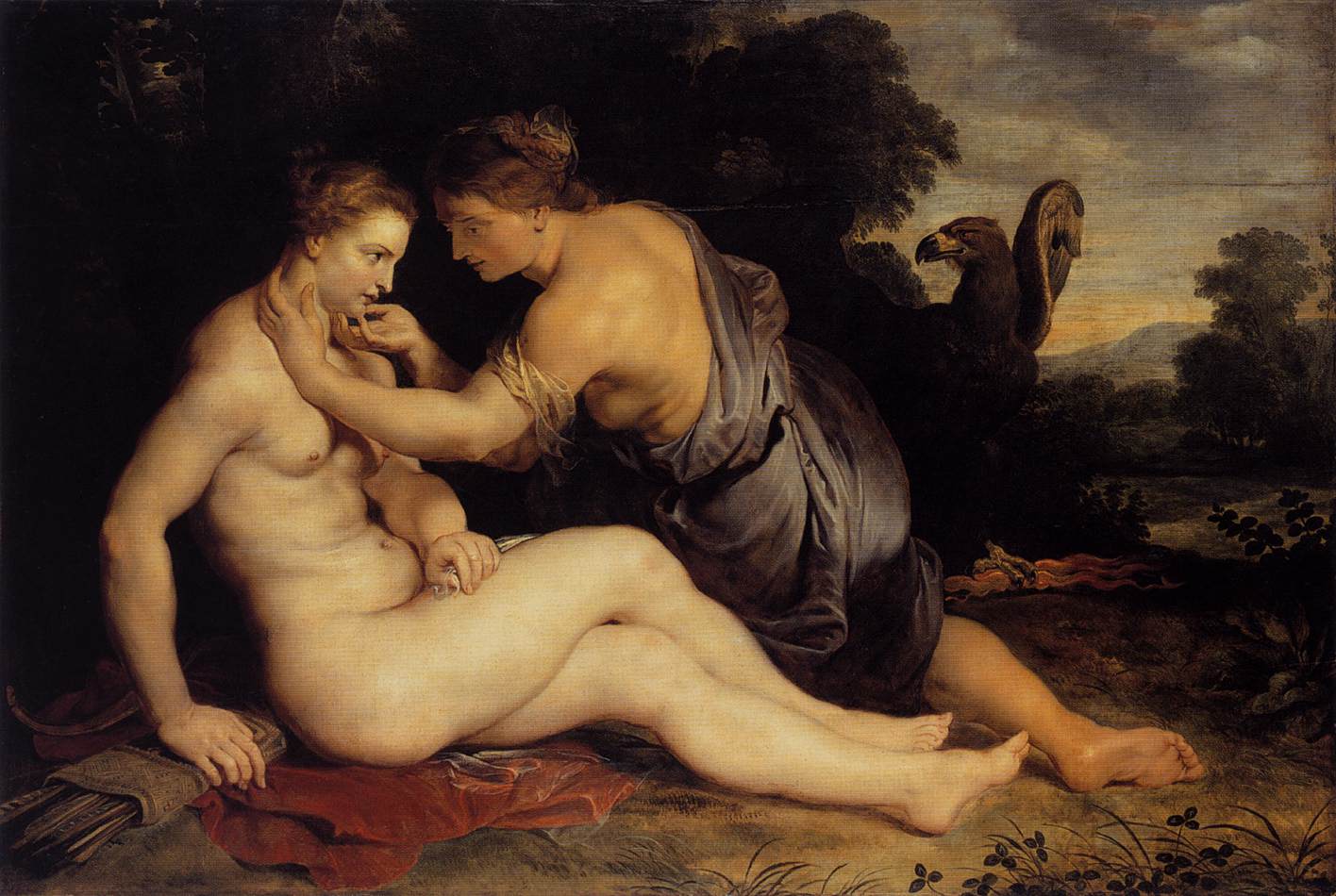
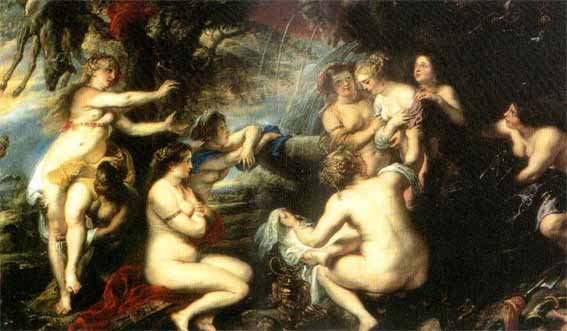
In the 17th century, Rubens had painted both Callisto in two scenes. His 1613 picture Jupiter and Callisto is now in the Staatliche Museen Kassel (but not on their website as far as I can see), and Diana and Callisto in 1640 (now in the Prado, probably on their site, but they seem to actively discourage linking).

Jacob de Wit's 1727 painting now in Amsterdam's Rijksmuseum also shows Jupiter and Callisto.

François Boucher seems to have been particularly fond of the theme of Jupiter and Callisto. This 1744 example (below, top) is now in Moscow's Pushkin Museum (not in their online collection). New York's Metropolitan Museum has another painting dated 1763, while the Wallace Collection in London has a 1769 version. As a side note, some sites showing Boucher's Diana Leaving Her Bath (1742) (below, bottom) say that Diana's companion in the painting is Callisto, I don't know on what evidence. The Louvre's page on this picture says nothing about who she might be.


Richard Wilson painted a Landscape with Diana and Callisto (now in Liverpool's Lady Lever Gallery) in 1757. The reproduction on the gallery's website is rather small, but the text is very informative.

Slightly later than Boucher, Jean-Honore Fragonard produced a painting on this subject in 1778.
(Unless otherwise noted, all illustrations are public domain images from wikimedia commons.)