Showing posts with label titian. Show all posts

24 July 2009

Perseus and Andromeda: The 16th century

In my previous post, we looked at Burne-Jones's series of pictures based on the stories of Perseus, but now let's look at art based on the story of Perseus and Andromeda in more detail. It was a very popular subject(damsels in distress who are suffering from a variety of wardrobe malfunctions sold well we must assume), so again we'll take it century by century, starting in the 16th century. (Wikicommons picture of the constellation Perseus by Torsten Bronger. Used under GNU Free Documentation Licence.)


This picture was painted by Piero di Cosimo around 1513 and is now in Florence's Uffizi Gallery.

Around 1524 Nicola da Urbino created a dinner service for Isabella d'Este, duchess of Mantua, decorated with scenes from the Metamorphoses. The one showing Perseus and Andromeda is now in Boston's Museum of Fine Arts.


In the mid 1550s Titian painted the above picture, which is now in London's The Wallace Collection.


This painting from 1570 is by Vasari and is now in Florence's Palazzo Vecchio. 10 years later Veronese painted Perseus Rescuing Andromeda, which is now in Rennes's Musée des Beaux-Arts.


Our last painting from the 16th century was painted in 1593 to 1594 by the Cavaliere d'Arpino (aka Giuseppe Cesari). It is now in the St. Louis Art Museum. (Unless stated otherwise, all pictures are taken from wikicommons where they are said to be in the public domain)

20 June 2009

Danae: the 16th Century

Ovid does not tell the story of Danae in the Metamorphoses but alludes to it several times with reference to her son. Nevertheless, she has proved a popular subject for artists. Danae was the only child of Acrisius, king of Argos, who had been told by an oracle that she would have a son who would kill him. To avoid this, Acrisius locked Danae up in a room at the top of a tall tower. That randy old god Zeus/Jupiter saw her and fell for her. He came to visit her as a shower of gold, and in time she bore a son to him. Rather than kill his relatives, which would provoke the Furies, Acrisius stuffed Danae and her son, Perseus, into a chest which he threw into the sea, thus making Poseidon/Neptune responsible for their fate. Of course they survived and Perseus grew up to become a hero.


Our first picture was painted by Jan Gossaert (aka Mabuse) in 1523. It is now in Munich's Alte Pinakotek.


The above picture was painted around 1531 by Correggio. It is now in Rome's Villa Borghese.


Titian painted various versions of Danae and the shower of gold in the 1550s. The ones shown above are in (from top to bottom):
Naples's Museo di Capodimonte (but not on their website),
Madrid's Prado (type Danae in the search box -- don't miss the informative audio file),
St. Petersburg's State Hermitage, and
Vienna's Kunsthistorisches Museum.
(Feel free to play spot the differences with them.)


At some point in the second half of the 16th century Tintoretto painted the above picture, which is now in Lyon's Musée des Beaux-Arts, but not on their website. (all images come from wikicommons and are in the public domain)

01 May 2009

Juno in the Underworld 1

In Ovid's next story, Juno gets angry with Ino, Semele's sister, and decides to punish her. This involves a trip down to the underworld, where she comes across some people being punished for their crimes on Earth. In this post we'll be looking at the punishments suffered by four of these people:Tityus, Tantalus, Sisyphus, and Ixion. (all of the images below are in the public domain and taken from wikicommons)


Both Titian and de Ribera painted sets of four paintings, one for each of the four. The two paintings by Titian above show Tityus (top) and Sisyphus (bottom). Dating from 1548-1549, they are now in Madrid's Prado ( here and here). The other two paintings in the set, Tantalus and Ixion, were unfortunately lost in a fire in 1734. Two of de Ribera's 1632 paintings are also in the Prado: Tityus and Ixion (below).


Michelangelo's 1532 drawing of Tityus is in the Royal Collection, and was used by Bernardi as the design for the intaglio shown below, which was cut around 1530 and is now in London's British Museum.


A drawing of Tantalus by Hans Holbein the Younger dating from between 1535 and 1540 can be seen in Washington's National Gallery of Art. Assereto's picture of Tantalus is from the first half of the 17th century and is now in Graz's Landesmuseum Joanneum (scroll down). Eric Henry has an animated version of Tantalus's torments called Sometimes I Feel Like This on his Moving Pictures site.

The picture of Sisyphus below was painted in 1920 by Franz von Stuck and is now in a private collection. The contemporary artist Michael Egbert took the theme of Sisyphus Sleeping for a 1993 painting.


To finish off this post with, here is Jankovics Marcell's short animated film called Sisyphus, which was nominated for a 1976 Oscar.

22 February 2009

Lucretia: The 16th Century

Chapter IV in Saylor's book deals with the end of Rome's regal period and the beginnings of the Republic. The part of this story that has most inspired artists is the story of the rape of Lucretia by Sextus Tarquinius, the nephew of Tarquinius Superbus, the seventh and last king of Rome, and her subsequent suicide. Scenes from the story can be seen in almost strip cartoon fashion in the two pictures below. The upper picture was painted in 1500 by Botticelli, and is now in Boston's Isabella Stewart Gardner Museum. The lower picture was painted in 1528 by Breu the Elder and is now in Munich's Alte Pinakothek but not on their website.


This 1518 picture of Lucreitia's Suicide by Durer is also now in Munich's Alte Pinakothek, but not on their website.


Lorenzo Lotto's 1530-32 picture shown below is actually called a Portrait of a Woman Inspired by Lucretia. It is now in London's National Gallery.


Cranach the Elder seems to have been very fond of the subject of Lucretia. According to Houston's Museum of Fine Arts, his workshop produced dozens of pictures on this theme. One can be seen below, with others in Vienna's Liechtenstein Museum (3rd picture down), Nizhny Novgorod's Art Museum (scroll down and click on middle thumbnail in the bottom row), and Helsinki's Finnish National Gallery.


Titian painted two pictures of Lucretia. The earlier one, painted in 1515, shows Lucretia with her husband trying to restrain her from committing suicide, and is now in Vienna's Kunsthistorisches Museum, while the later one (shown below), painted in 1571 near the end of Titian's life, shows the rape. The picture is in Cambridge's Fitzwilliam Museum, whose website has a detailed discussion of the painting.


Veronese painted Lucretia's suicide in 1580. The picture (shown below) is also in Vienna's Kunsthistorisches Museum (scroll down and click on leftmost thumbnail in the bottom row).


Let's close this look at Lucretia in the 16th century with the 1592 publication of Shakespeare's poem, The Rape of Lucrece. (all illustrations are from wiki commons and are in the public domain)

04 February 2009

Actaeon Update 2

Titian's "Diana and Actaeon" is to stay in the UK after the National Galleries of Scotland and London's National Gallery raised enough money to buy the painting from the Duke of Sutherland.The Guardian, The Scotsman, and the BBC have coverage. (public domain image from wiki commons)

The Independent has a detailed discussion of the symbolism and artistic techniques used in the painting.

23 October 2008

Actaeon Update

One of the paintings we looked at in my post on Actaeon from the 15th to 17th centuries was Titian's "Diana and Actaeon" (left). Judith Weingarten of Zenobia: Empress of the East has brought to my attention The Archaeology Review's rather derogatory comment on the painting stemming from a BBC report that Titian's painting is now on display in London's National Gallery in an attempt to raise £50 million to prevent it being sold off abroad by its owner, the Duke of Sutherland. When this news first broke in August, The Guardian's coverage provoked lively debate.

19 September 2008

Actaeon - 15th to 17th centuries


Book III of the Metamorphoses continues with the story of Actaeon. We start our look at representations of this theme with a majolica dish dating from the 1490s and now in Bath's Holbourne Museum of Art, showing the story of Actaeon in the centre and the story of the Centaurs and the Lapiths around the rim. (photograph by HaSee released into the public domain via wikipedia)


The picture to the left is Louis Cranach the Elder's picture of Diana and Actaeon, from the first third of the 16th century. It is now in Connecticut's Wadsworth Athenaeum, but does not appear to be on their website.


The two pictures of Actaeon above are both by Titian, the one on the left, called Diana Surprised by Actaeon, being earlier (1556-1559 -- now in The National Galleries of Scotland) and the one on the right, called The Death of Actaeon, being later (1565-1576 -- now in London's National Gallery). Lonely London Lad's song was inspired by the Diana Surprised by Actaeon, and the two paintings form the video accompaniment to this performance of the aria "Oft she visits this lov'd mountain" from Purcell's "Dido and Aeneas".


Moving on to the late 1580s and and early 1590s, the above left picture is by Bassano, (now in the Art Institute of Chicago) while a drawing by Spranger is now in New York's Metropolitan Museum. The above right picture is by Cesari (1603), and is now in Budapest's Szépmûvészeti Múzeum, but does not appear to be on their website.

A decade or so later, Joachim Anthoniesz Wtewael of the Netherlands produced Actaeon Watching Diana and Her Nymphs Bathing, now in Boston's Museum of Fine Arts. Dresden's Gemäldegalerie Alte Meister (ninth picture down -- can't link any more closely) dates Albani's painting of Diana and Actaeon to before 1630. In 1634, Rembrandt combined the stories of Diana and Callisto and Diana and Actaeon in a single picture now in Anholt Castle in North Rhine-Westphalia (a tip of the hat to Judith Weingarten, who brought this to my attention in a comment on my second post about Callisto).

St. Petersburg's The Hermitage has Maratti's Landscape With Diana and Actaeon from the late 1660s, while Liechtenstein Castle takes us up to the 1690s with Franceschini's Diana and Acteon .

Backtracking slightly to 1684, the French composer Charpentier wrote a pastorale called Actéon, an extract from which can be viewed below.

12 August 2008

Europa and the Bull


Ovid's next story (in Tony Kline's translation as usual), at the end of Book II, and somewhat cursorily finished off at the beginning of Book III, tells of Europa's abduction by Jupiter. Jupiter fell in love with Europa, a Phoenician princess. He took the form of a white bull and together with a herd of cattle he met the princess while she was playing on the beach. He coaxed her onto his back and splashed about in the shallows, and then headed out to sea with her on his back, taking her to Crete. (Robert Scarth's picture of bull via wikimedia commons, used under creative commons licence 2.5)

This story has inspired an overwhelming number of artists, so I'll divide my exploration of this theme into a number of posts.

Let's start with two works from the 15th century. Bartolomeo Bellano or Vellano sculpted this bronze of Europa and the Bull in the 1480s or 1490s (now in Florence's Museo Nazionale del Bargello but not on their website). Another bronze possibly by Andrea Briosco (aka Il Ricco) is now in Budapest's Szépművészeti Múzeum.

Dürer's 1490 sketch for this subject is now in Vienna's Albertina museum, but again not on their website as far as I can see.


This 1560 picture by Titian is now in Boston's Isabella Stewart Gardner Museum. Veronese painted two versions of Europa and the Bull, the one shown below is in London's National Gallery, the other is in the Doge's palace in Venice.

(Both illustrations in the public domain, the Titian via wiki commons media, the Veronese via Museum Syndicate.)

17 July 2008

Callisto -- Paintings

(Picture by Torsten Bronger via wikipedia, used under GNU Free Documentation License)

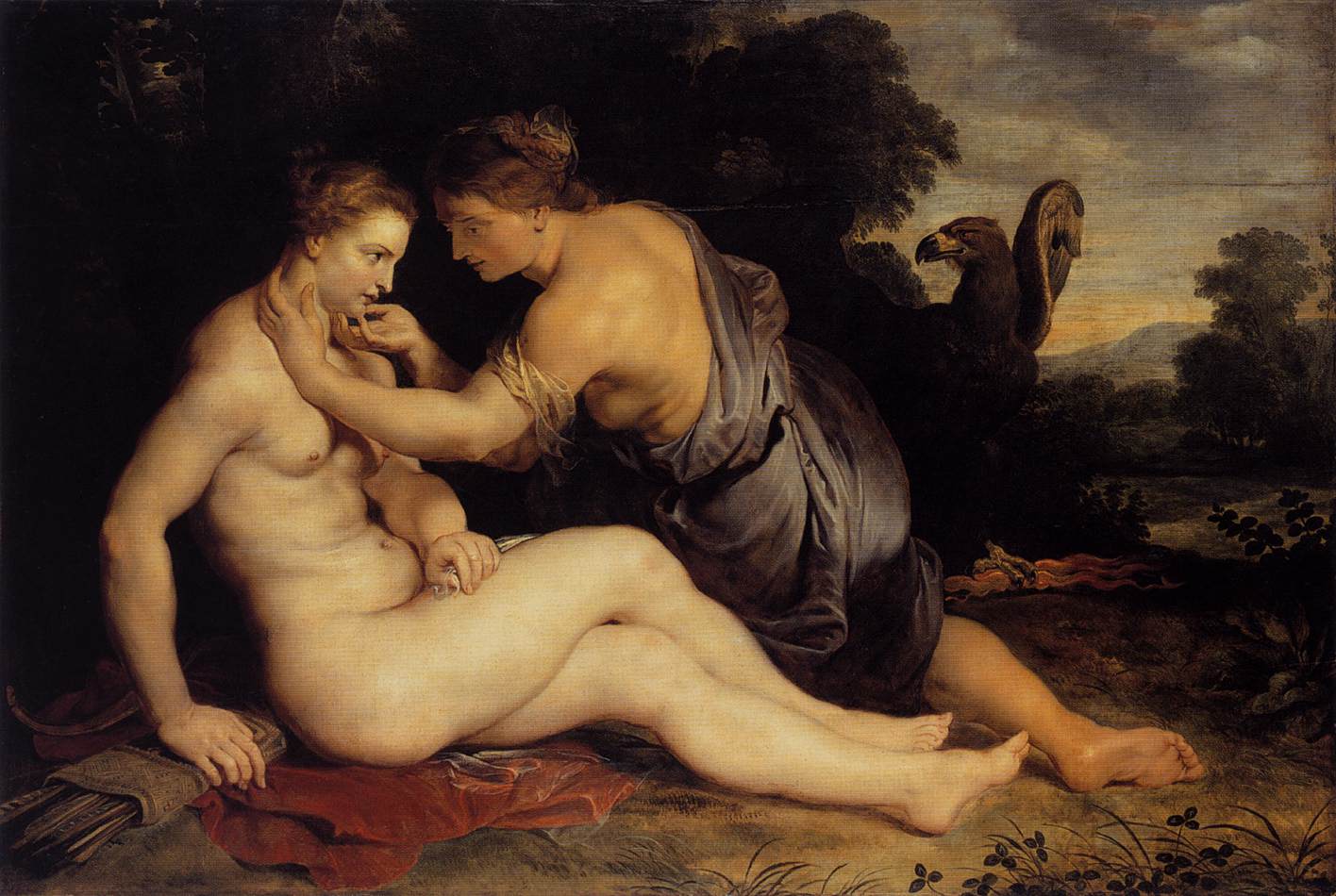
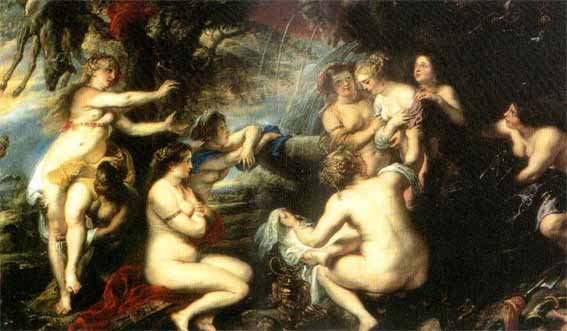
As I said in a previous post, Jupiter's attempt to seduce Callisto and the discovery of her pregnancy by Diana have proved the main focus in the story for artists. Earlier artists (in the 16th century) seem to have been more attracted to Diana's discovery of Callisto's pregnancy, while later artists (in the 18th century) seem to have been more attracted to Jupiter's attempt to seduce Callisto. The 17th century presents more of a mixture of these themes.

Dosso Dossi painted the incident in 1528. The painting is now in Rome's Galleria Borghese but does not seem to be on their website.


Below are two versions of the subject by Titian: the top one is from the late 1550s and is now in Edinburgh's National Gallery of Scotland while the bottom one is from 1566 and is now in Vienna's Kunsthistorische Museum.


Paul Bril painted a landscape with Diana and Callisto, probably in the 1620s, while in the late 1630s Hendrick Bloemart painted this version of the scene (right).


Left is a 17th century engraving by Gérard de Lairesse while below left is an engraving based on a picture from the 1740s by Jacopo Amigoni. Although many art poster and reproduction sites on the internet offer colour pictures, none of the ones I've looked at give any information as to where the original might be.


In the 17th century, Rubens had painted both Callisto in two scenes. His 1613 picture Jupiter and Callisto is now in the Staatliche Museen Kassel (but not on their website as far as I can see), and Diana and Callisto in 1640 (now in the Prado, probably on their site, but they seem to actively discourage linking).

Jacob de Wit's 1727 painting now in Amsterdam's Rijksmuseum also shows Jupiter and Callisto.

François Boucher seems to have been particularly fond of the theme of Jupiter and Callisto. This 1744 example (below, top) is now in Moscow's Pushkin Museum (not in their online collection). New York's Metropolitan Museum has another painting dated 1763, while the Wallace Collection in London has a 1769 version. As a side note, some sites showing Boucher's Diana Leaving Her Bath (1742) (below, bottom) say that Diana's companion in the painting is Callisto, I don't know on what evidence. The Louvre's page on this picture says nothing about who she might be.


Richard Wilson painted a Landscape with Diana and Callisto (now in Liverpool's Lady Lever Gallery) in 1757. The reproduction on the gallery's website is rather small, but the text is very informative.

Slightly later than Boucher, Jean-Honore Fragonard produced a painting on this subject in 1778.
(Unless otherwise noted, all illustrations are public domain images from wikimedia commons.)