After Perseus defeats the sea monster and rescues Andromeda, the Ethiopians hold a feast in his honour and he tells the story of how he defeated Medusa.
Benvenuto Cellini's famous statue of Perseus with the head of Medusa is in Florence and dates from 1545-1554. John Singer Sargent produced a series of sketches and paintings of the statue, two of which are shown below, in the first decade of the 20th century. The upper picture is now in Washington's National Gallery of Art, and the lower picture is in the Santa Barbara Museum of Art (but not on their website). For more on Sargent's pictures of the statue see this site.
Youtube has a short slideshow of photos of Cellini's work taken from various angles:
The above painting of the head of Medusa on a shield is by Caravaggio. Painted in 1596, it is now in Florence's Uffizi Gallery (scroll down). Caravaggio painted another version of the same picture a year or so later which is now in a private collection and not online that I can see. Caravaggio's painting is discussed in this Guardian article.
Painted about the same time, and also now in the Uffizi is this painting by an unknown Flemish artist. For a long time it was thought to be one of the paintings of Medusa Leonardo Da Vinci is known to have painted but which have been lost. It served as the inspiration a poem by Percy Bysshe Shelley (dialogic hypertext here).
The above picture of Medusa's head was painted in 1617-1618 by Rubens and is now in Vienna's Kunsthistorisches Museum. It is discussed in detail here.
Bernini produced a bust of Medusa in the 1640s, which is now in Rome's Musei Capitolini, where it is currently undergoing restoration.
Maffei's picture of Perseus Cutting off Medusa's Head (above) was painted in 1650 and is now in Venice's Gallerie dell'Accademia, but is not on their website. (all images are in the public domain and come from wikicommons)
Despite his key role in drama, the story of Tiresias has not really proved inspirational to artists. He puts in a rare appearance in this picture from a private collection, which links Tiresias's story to the next story, that of Echo and Narcissus with a prophesy of Narcissus's fate. The stories of Echo and Narcissus were originally two separate stories, which Ovid, as far as we know, was the first to combine. (public domain picture of narcissi by bormaniuss via wikipedia)
Echo was a nymph who covered for Jupiter on one of his amorous forays by distracting Juno with her chatter. As a punishment Juno condemned her to only be able to repeat the last words anyone said. Echo fell in love with the handsome Narcissus, who spurned her, and all the others (male and female) who desired him. One rejected lover cursed him, wishing that he would fall in love with someone unobtainable. When Narcissus saw his reflection in a lake, he fell in love but was unable to reach this bewitching figure. Unable to leave the image of his love, Narcissus died and was changed into the flower that bears his name. Echo also wasted away so that only her voice, still repeating people's last words, is heard in lonely places.
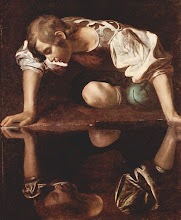
Our first two pictures show Narcissus by himself. The above 1595 picture of Narcissus by Caravaggio is now in Rome's Galleria Borghese. For some reason it is only on the Italian version of the site, and not on the English version. Jacob Pynas painted a Mountain Landscape with Narcissus in 1628, now in London's National Gallery. (public domain picture via wikicommons)
Poussin painted two versions of the story, the earlier (above left) from around 1630 is now in the Louvre, while the later (above right) is in Dresden's Gemäldegalerie Alte Meister (use Narziss as the search item in the box marked Volltextsuche in der Motivliste. Why they don't allow direct links I don't know). At about the same time Claude Lorrain painted a Landscape with Narcissus and Echo, now in London's National Gallery. (public domain pictures via wikipedia)
Turner's picture of Narcissus and Echo (now in London's Tate Gallery) was painted in 1805, while a year earlier the American painter Benjamin West painted the above painting (now in a private collection). (public domain picture via Museum Syndicate)
This 1881 picture of Narcissus by Benczúr Gyula is now in Budapest's Magyar Nemzeti Galéria, but does not appear to be on their website. (public domain picture via wikicommons)
Perhaps one of the most popular paintings of Echo and Narcissus, the above picture by John William Waterhouse was painted in 1903 and is now in Liverpool's Walker Art Gallery. A site devoted to Waterhouse has an article on the models who posed for the picture. Almost as popular is Salvador Dali's Metamorphosis of Narcissus, painted in 1937 and now in London's Tate Gallery.(picture courtesy of WebMuseum under Creative Commons 3.0 licence)
In the performing arts, Guillaume Apollinaire wrote Les Mamelles de Tirésias in 1903, though it was not performed until 1917. Poulenc wrote an opera based on Apollinaire's Les Mamelles de Tirésias during the Second World War and it was first performed in 1947. In 1951 Constant Lambert's ballet about Tiresias was first performed.
Gluck wrote an opera on Echo and Narcissus in 1779. YouTube has an aria. YouTube also has a pas de deux called Echo and Narcissus, though only the dancers are named, not the composer. I'm no expert but I certainly don't think it's the Lambert one. There are the usual kids in bedsheets dramatisations, and this rather nice short film called "An Echo of Narcissus", though Echo doesn't seem to appear.
Today, September 30th, is St. Jerome's day. St. Jerome is the patron saint of translators due to his translation of the Bible into Latin, which became the standard Latin translation known as the Vulgate. (public domain picture by Caravaggio, from wikicommons)
altogether something
-
Here's a story of curiosity and exploration and enjoying where it took me.
I was (orig. AmE) *fooling around with *a corpus interface (in preparation
for...
Horrible Histories: The Movie: Rotten Romans
-
The original *Horrible Histories* books (the first was *The Terrible Tudors*
in 1993) came out while I was right in the target age group, and they were
...
2018 books chats - corrected
-
January 3 & 17, February 7 Three Stones Make A Wall by Eric Cline eBook
Author chat February 21 I Am Livia by Phyllis T Smith eBook March 7 & 21
Catullus's...
Latest edition of Antiquity
-
The latest edition of Antiquity is worth a look. Two articles in particular
are of especial interest: Discovery of an enormous late Viking Age fort in
Denm...
Grenfell Tower and the Fire of Rome
-
There was a good episode of The Long View on Radio 4 last week, looking at
a terrible fire in Glasgow in 1905 as a ghastly parallel of the Grenfell
Tower. ...
A LEADING LADY IN ELEPHANTINE ON THE NILE (UPDATED)
-
*Meet Lady Sattjeni, daughter of Governor Sarenput the younger.*
I'd love to be able to tell you what she looked like ... but, really, I
can't. Her funerar...



 Posts


